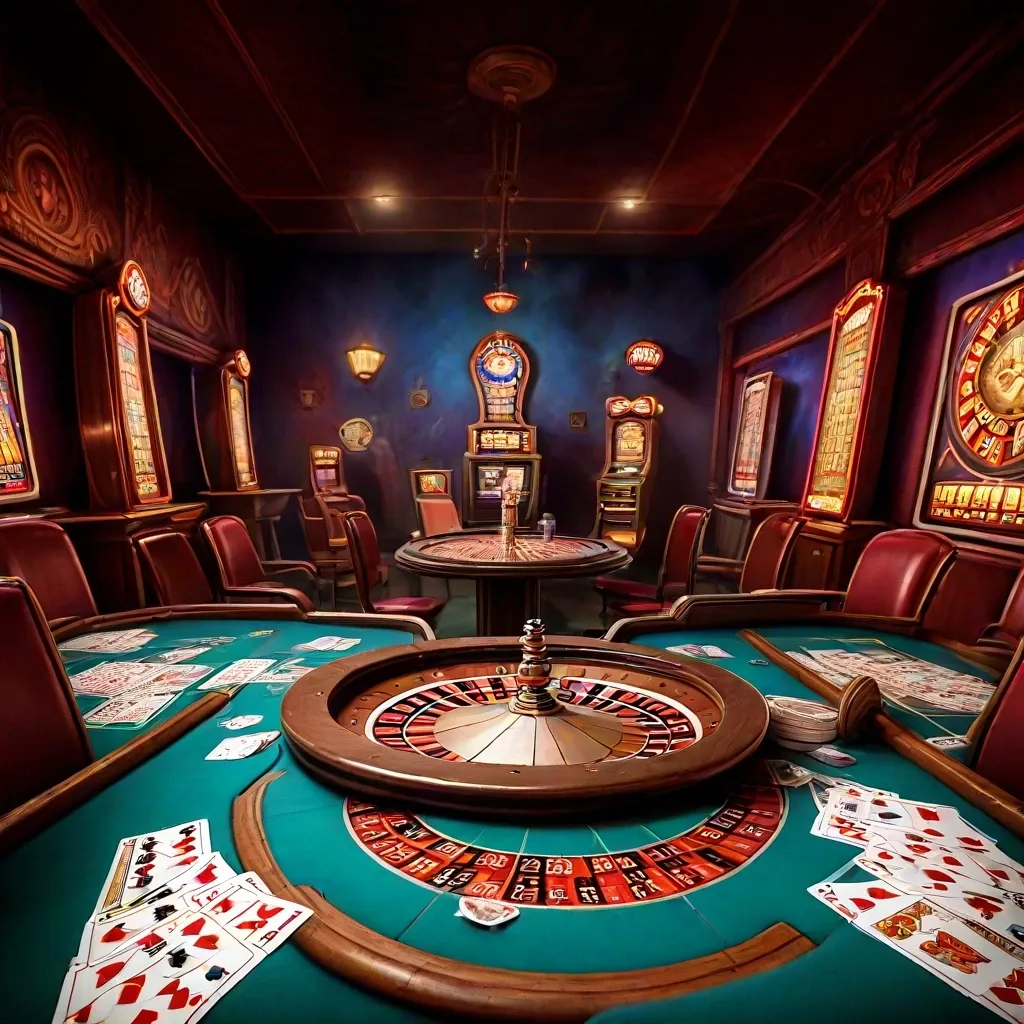
Ever felt that electric buzz at the casino, the air thick with possibility? Maybe you’ve heard whispers of the “hot streak” or the “due win,” tales that ignite a gambler’s hope. It’s a seductive world, filled with glitz and the tantalizing promise of a fortune. But lurking beneath the surface are persistent casino myths and gambling myths that, while entertaining, are incredibly costly. These are the common misconceptions that chip away at your bankroll and cloud your judgment. We’re here to cut through the fog with expert insights, exposing the truths behind the most prevalent casino game myths. Believing these fallacies isn’t just a minor slip-up; it’s a direct, often brutal, hit to your wallet and your overall gaming experience.
The ‘Gambler’s Fallacy’ and Its Cousins: The Illusion of Due Outcomes
Let’s talk about a persistent myth that trips up a surprising number of people, especially those dabbling with chance: the gambler’s fallacy. It’s this sneaky, ingrained belief that past random events have some sort of bearing on future random events. Think about it – the roulette wheel just spun red five times in a row. Does that mean black is “due” next? Nope. And coin flips are a classic: Heads, heads, heads… surely tails is coming up? The reality is, each spin, each flip, is an entirely separate, independent event. The odds don’t magically shift because of what happened before. This misconception about gambler’s fallacy and independent events is a cornerstone of many probability myths, creating a warped sense of randomness that can lead folks down a rather expensive rabbit hole, mistaking past outcomes for a predictor of the future. It’s a tricky beast, and understanding its grip is key to navigating the world of chance without falling prey to its deceptive charm.
Why Past Results Don’t Predict Future Ones
Ever seen a coin land on heads what feels like a million times in a row? It’s tempting to think tails is practically guaranteed for the next few flips, right? Well, that’s where the whole idea of statistical independence comes in. Each flip is its own tiny universe; it has no memory of the previous ones. The coin doesn’t “know” it’s been on a heads streak. Similarly, on the roulette wheel, a string of reds doesn’t magically make black more likely. While it’s true that over an astronomical number of spins, you’d expect roughly a 50/50 split between red and black, that’s about long-term averages. Short-term streaks, no matter how wild, are just that – streaks. They don’t alter the fundamental probability distribution of the next event. The concept of expected value remains constant, unaffected by the whims of history. These events have no memory; they start fresh every single time.
The Dangerous Dance of Chasing Losses
Picture this: someone is on a bit of a losing streak at the slots. Instead of walking away, they start believing the machine owes them a win. They might even increase their bets, thinking they’re “due” for a big payout soon. This is the heart of chasing losses, a classic symptom of the gambler’s fallacy in action. It’s a vicious cycle, a dangerous form of betting escalation driven by a faulty belief. The initial losses, fueled by flawed predictions, become bigger losses as the individual tries to recoup their money with increasingly desperate bets. This is a profound risk management failure, leading straight into destructive betting. The psychological trap is potent: the hope of a “comeback” blinds them to the escalating financial and emotional toll. It’s a path that rarely ends well, often leaving individuals in a far worse financial and mental state than when they started.
Busting the Myths of ‘Hot’ and ‘Cold’ Machines
Ever heard that whisper in the casino, the one about a slot machine being “hot” and about to hit big, or “cold” and needing a good payout soon? It’s a persistent belief, isn’t it? This idea that slot machines operate in some kind of predictable cycle, churning through losing streaks before a big win arrives, is as old as the machines themselves. People love to talk about ‘hot or cold slots,’ convinced they’ve cracked the code. But here’s the blunt truth: it’s all a myth. Slot machines these days are powered by sophisticated pieces of technology called Random Number Generators (RNGs). Think of it like this: every single second, a lottery draw is happening, perfectly random, completely independent of what happened a minute ago or what’s going to happen a minute from now. Each spin on a slot machine is exactly that – a unique, isolated event, decided by a complex algorithm. The concept of ‘due’ payouts? Simply doesn’t exist in the realm of modern slot machine myths. Forget cycles, embrace the randomness.
The Truth About Random Number Generators (RNGs)
So, what exactly are these much-talked-about Random Number Generators (RNGs)? At their core, RNGs are incredibly advanced computer programs. They don’t wait for you to hit the spin button; they are constantly, non-stop, generating sequences of numbers. The magic, or more accurately, the pure mathematical probability, happens at the infinitesimally small moment you press ‘spin’. The specific number generated at that precise instant is what dictates the outcome of your spin – which symbols land on the paylines. This ensures absolute slot fairness. These systems aren’t just conjured up; they undergo rigorous testing and independent audits to guarantee their certified randomness and flawless operation. Understanding these core slot mechanics is key to dispelling the old wives’ tales.
Perceived Patterns: Apophenia and Confirmation Bias
Why is it so hard to let go of the ‘hot and cold’ idea then? It often boils down to two fascinating psychological quirks: apophenia and confirmation bias. Apophenia is our brain’s tendency to see meaningful patterns in random data, even when none exist. We might ‘remember’ the one time we finally won after a long dry spell, becoming convinced the machine was simply ‘due’. Meanwhile, the countless losses that occurred in between? They tend to fade into the background. This is where confirmation bias kicks in. We actively seek out and interpret information that confirms our existing beliefs. If we believe a machine is ‘hot’, we’ll focus on every near miss or small win as proof, conveniently forgetting the numerous spins that yielded nothing. It’s this powerful psychology of gambling and these ingrained cognitive biases that make pattern recognition so tempting, even when the underlying reality is purely random.

Card Games: When Strategy Meets Illusion
The allure of card games, from the quick calculations of Blackjack to the intricate dance of Poker, often comes swirled with a generous helping of myths and misconceptions. It’s easy to get caught up in the mystique, believing in magical formulas or infallible systems that guarantee a win. But peel back the veneer, and you’ll find that genuine success in these games isn’t about luck or outlandish prophecies; it’s about honed skill, a sharp mind, and understanding the underlying mechanics. Let’s untangle some of the more persistent myths to reveal the real strategic heart of card games.
Card Counting: Skill, Not Magic (And Not Illegal)
One of the most notorious concepts in card game lore is card counting, particularly in Blackjack. Far from being a magical ability to predict the future, card counting is a sophisticated strategy based on tracking the ratio of high cards to low cards remaining in the shoe. As the deck depletes, a successful card counter can deduce when the odds shift in their favor, allowing for adjusted betting and playing decisions. It requires intense concentration, rapid mental calculation, and a deep understanding of Blackjack strategy. Crucially, it’s not illegal. However, casinos, being businesses that thrive on a house edge, are well within their rights to ban players they suspect of employing this skill-based advantage. For those playing online, the effectiveness of card counting is significantly diminished due to continuous shuffling machines, making the traditional approach a virtual impossibility.
The Dealer’s ‘Edge’ vs. The House Edge
There’s a common misunderstanding that the dealer themselves possesses some kind of personal “edge” that influences the outcome of a hand. This is largely a myth. Dealers are rigorously trained to follow strict protocols and algorithms, acting as impartial agents of the casino. They have no ability to deviate from the game’s rules or manipulate the cards. The real “edge” at play is the mathematical house edge, a statistical advantage built into the very structure of casino games like Blackjack and Roulette. This edge ensures that, over millions of hands, the casino will always come out ahead. When playing at a table, it’s this inherent mathematical advantage, not the dealer’s actions, that forms the persistent challenge.
Poker Facefallacies: Reading Tells and Bluffing Myths
Poker is a grand arena for psychological warfare, but here too, myths abound. The idea that a single, fluttering eyelid or a nervous cough is a guaranteed “tell” is often overstated. While physical tells do exist, they are typically subtle, require immense experience to interpret accurately, and can easily be faked or misinterpreted. Similarly, bluffing isn’t just about randomly betting big with weak cards hoping for the best. Successful bluffing in poker is a meticulously timed tactic, relying on a deep understanding of player psychology, table position, betting patterns, and the probabilities of your opponents folding. It’s a calculated risk, not simply an act of defiance against the odds, and reading your opponents is a nuanced skill, not a superpower.
Table Games: The Allure and Danger of Betting Systems
Ah, table games. The shimmering felt, the hushed anticipation, the clinking chips. And then there are the whispers, the legends, the irresistible allure of a “system” that promises to crack the code. Especially in games like Roulette, the belief that you can engineer a win, that a clever sequence of bets can somehow outsmart the casino’s built-in advantage, is a persistent myth. We’re talking about the siren song of roulette systems, the notion that something like the Martingale system, D’Alembert, or Labouchere can magically erase the house edge. It’s a seductive idea, isn’t it? The fantasy of turning a night at the tables into a guaranteed payday. But let’s peel back the veneer; these betting systems myth are often more about chasing losses than consistent wins.
Why Martingale and Other Systems Are Doomed to Fail
Let’s dive straight into the deep end with the infamous Martingale system. The idea is simple: double your bet after every loss. Sounds foolproof, right? What it really means, though, is a recipe for rapid financial disaster. Imagine hitting a streak of, say, six reds in a row on an even-money bet like red/black. Your bets would go from $1 to $2, then $4, $8, $16, $32, and finally $64. Suddenly, you’re staring down a massive bet, potentially bumping right up against the table limits. Even if you eventually win, that single win only recovers your losses and grants you a meager $1 profit, while one more loss could wipe you out. These systems don’t change the fundamental roulette odds; they only change thevariance* of your losses. You might win small, small amounts often, but the inevitable large loss due to table limits or depleted bankroll management will dwarf those small wins, leading to a significant negative expectation. It’s a statistical inevitability, not a clever trick.
Roulette’s True Nature: Pure Chance
At its heart, Roulette is a game of pure, unadulterated chance. The spinning wheel has no memory. Each number appearing has precisely the same probability as any other number, on every single spin. The ball landing on red twenty times in a row doesn’t make black “due.” This concept of random outcomes is crucial; the wheel has no memory, and there’s no amount of skillful betting that can influence the physics of a spinning ball and wheel. Unlike games where strategic decisions can influence the outcome, like blackjack, predicting roulette is an exercise in futility. The house edge isn’t a glitch to be exploited; it’s the inherent design of the game, ensuring that over the long run, the casino will always have the advantage.
The Casino’s ‘System’: Rigged Games and Unfair Practices
Let’s dive headfirst into a persistent whisper that circles the glitzy world of casinos: the idea that the games are inherently rigged, a sly manipulation designed to ensure you walk away with less than you arrived with. It’s a compelling narrative, a way to explain those unlucky streaks, but the reality is a whole lot more structured – and frankly, more reassuring. For any legitimate casino, the focus isn’t on secretly tinkering with the odds; it’s about navigating a sea of stringent regulations and embracing technology that often makes their operations more transparent than you might think. The notion of rigged casino games is largely a myth, thanks to a robust framework of control and a business model that doesn’t require such desperate measures.
The Rigor of Regulation and Auditing
Imagine a world where casinos operate entirely unchecked – it’s a chilling thought, right? Thankfully, that’s not the case, especially not for licensed casinos. Governing bodies like the Malta Gaming Authority (MGA) and the UK Gambling Commission (UKGC) are the gatekeepers, setting strict license requirements and maintaining unwavering oversight. These aren’t just names on a badge; they are active entities that demand rigorous third-party audits of all games and software. Every spin, every hand dealt, can be scrutinized to ensure it adheres to the principles of fair play. These audits are crucial, verifying that the random number generators (RNGs) are just that – random – and that the outcomes are truly unpredictable.
Why Casinos Don’t Need to Cheat
The simplest answer to why casinos don’t need to rig games is the house edge advantage. It’s a mathematical certainty baked into every game. Think of it like this: over millions and millions of wagers, the casino will statistically win a small percentage more than they pay out. This built-in profitability is enough. The risk versus reward of attempting to cheat – the catastrophic reputation damage, the hefty fines, the complete loss of their license – far outweighs any perceived benefit. Running a profitable business doesn’t require subverting the game mechanics; it relies on the sheer volume of play and the inherent statistical advantage. It’s a much cleaner, more sustainable business model.
Online Casinos: Transparency Through Technology
Online casinos, in many ways, offer a level of transparency that can be harder to find in physical establishments. Every single outcome of an online game is meticulously logged, creating an unalterable digital trail. This digital auditing capability makes it incredibly easy for both players and regulators to verify fairness. Furthermore, many online slots openly advertise their Return to Player (RTP) percentages, giving players a clear understanding of the theoretical payout rate over extended play. This commitment to online casino fairness, backed by RNG audits from independent bodies, means you’re often getting a much more straightforward experience than the whispers might suggest.

Bonus and Promotion Myths: Is It Really ‘Free Money’?
Here’s the thing about those dazzling casino bonuses and juicy promotions – they often feel like a sneaky magician’s trick, right? Everyone wants to believe it’s just free money landing in their account, but reality is a bit more complicated. Think of them less as a gift and more as a clever marketing tool, designed to get you spinning those reels and exploring new games. They come with strings attached, and understanding those strings is the whole game. It’s not about the bonus being impossible to cash out, it’s about understanding the rules of engagement. It’s easy to get blinded by the sparkle and forget to check the fine print, but that’s exactly where the real story unfolds.
Understanding Wagering Requirements (The Real Catch)
So, what exactly are these ‘wagering requirements’ that pop up everywhere? Essentially, it’s the amount of money you need to bet before you can actually withdraw any winnings derived from a bonus. If you see something like ‘playthrough 40x’, it means you have to bet 40 times the bonus amount. For instance, if you snag a $10 bonus with a 40x wagering requirement, you’ll need to place bets totaling $400 before those potential winnings are truly yours to keep. It’s not a penalty, just a condition of unlocking the bonus cash – a pretty standard part of the online casino world, often misunderstood as outright bonus abuse if not met.
When ‘Free’ Isn’t Actually Free
‘Free spins’ and ‘no deposit’ bonuses sound like the ultimate score, but they often come with their own set of limitations. These offers aren’t designed to make you rich overnight. You’ll often find win caps, meaning there’s a maximum amount you can withdraw from your free spins winnings, no matter how luck you are. Plus, certain games might be excluded from play with bonus funds, and there might even be a minimum withdrawal amount to consider. It’s super important to dive deep into the full Terms & Conditions to get the full, unvarnished picture.
Choosing Bonuses Wisely
Navigating the world of casino bonuses can feel a bit overwhelming, but a smart approach can make a big difference. Instead of just grabbing the first offer that catches your eye, take a moment to evaluate. Look for bonuses with lower wagering requirements – these are generally much more achievable. Also, check out the bonus terms for fairness; are the expiry dates reasonable? Do the restricted games align with the games you actually enjoy playing? Comparing a few offers and understanding their structure will help you find the best casino bonuses that genuinely fit your play style and increase your chances of actually seeing some returns.
Actionable Insights: Playing Smart and Staying Informed
So, we’ve navigated the misty waters of casino myths, emerging with a clearer perspective. The real jackpot isn’t found in a lucky charm or a secret system, but in being an informed player armed with smart gambling habits. It’s about approaching casino entertainment with a strategic mindset, focusing on enjoyment rather than expecting a steady income. Think of it as a game of calculated fun, where preparation is your best bet. By understanding the landscape and playing by your own smart rules, you can ensure your casino experiences remain engaging and within your control.
Set Your Limits: The Ultimate Strategy
Forget chasing elusive wins; the only guaranteed victory in the casino is mastering your own play. This means establishing ironclad bankroll management and time limits. Decide beforehand exactly how much you’re willing to spend and for how long. Treat this money as entertainment budget, not an investment. If your limit is $100 for the evening, stick to it. If you’ve set a timer for two hours, pack it up when it rings. Utilizing responsible gambling tools offered by casinos can be a lifeline. These aren’t restrictions; they’re your shields, ensuring the fun stays fun and never creeps into stressful territory.
Know Your Games: RTP and Volatility Matter
Dive a little deeper into the mechanics of the games themselves. Understanding RTP explained, which stands for Return to Player, is crucial. In simple terms, it’s the theoretical percentage of wagers a game will pay back to players over an extended period. A higher RTP generally means a better theoretical return for you. Equally important is slot volatility. High volatility games offer larger, infrequent wins, while low volatility slots provide smaller, more frequent payouts. Neither is inherently ‘better,’ but knowing the game selection and understanding odds allows you to choose games that align with your playing style and bankroll tolerance, making the experience more predictable and enjoyable.
Navigating the Casino Floor with Confidence
So, you’ve armed yourself with the truth, shedding the weight of those persistent casino myths. Remember, true casino game knowledge isn’t about luck; it’s about informed decision making. By understanding what truly influences outcomes and what doesn’t, you’re empowered to approach every game with a clear, confident perspective. This expert advice is your ticket to a more enjoyable and, frankly, less costly gaming experience. Play responsibly, savor the entertainment, and let your newfound understanding guide your bets. The casino floor awaits, and with this knowledge, you’re ready to enjoy it.